


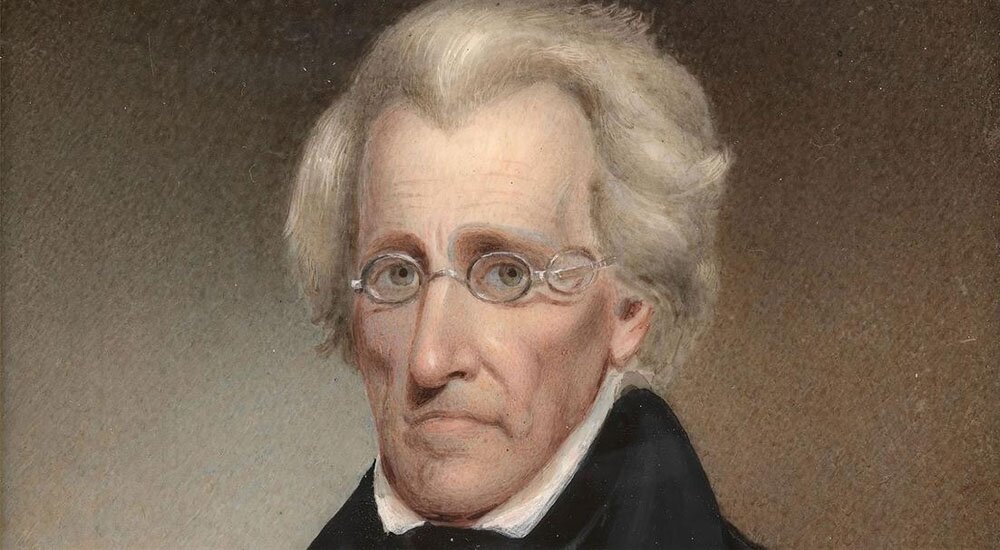
Longtime readers will know that I am no fan of the Trump presidency per se, though I will have to admit that between the Trump tax schematic (which needs tweaking, but overall shows promise), the selection of Neil Gorsuch to the U.S. Supreme Court, and the way in which progressives have shown their true colors in an orgy of rage and riots as they have been separated from the sacred temples of power? Glorious… simply glorious…
So this week’s bright shiny object for the progressive media has been nothing short of a spectacular rendition of historical revisionism — one that probably wasn’t a Donald Trump original, but a distillation of what Trump might have heard delivered elsewhere… perhaps conversation with Steve Bannon? Either way, the end result is fascinating:
I mean, had Andrew Jackson been a little bit later you wouldn’t have had the Civil War. He was a very tough person, but he had a big heart. He was really angry that he saw what was happening with regard to the Civil War, he said, ‘There’s no reason for this.’
Of course, the Washington Post had to give them the ol’ one-two punch, courtesy of the Ken Burns treatment:
Other self-appointed purveyors of truth such as Politifact and Snopes gave the statement their characteristic “false” and “not true” washes in efforts sadly reminiscent effort to paint Bush 43 as an idiot — Jackson was a racist, Trump likes Jackson, ergo Trump is a racist. QED.
NPR was a bit more nuanced in their critique, and it’s worth plumbing their statement if for no other reason than they interviewed Steve Inskeep, a noted Jacksonian biographer:
Q: The President said that he thinks if Jackson had “been a little bit later, you wouldn’t have had the Civil War.” Give some context here, do you think that’s true?
This much is true: Andrew Jackson, who was president from 1829-1837, helped to avert a plausible civil war, generations before the actual one. In the 1830’s, South Carolina insisted on its right to nullify, or ignore, federal law. The South Carolinians objected to taxes — federal tariffs on the imported goods they were buying from Europe.
Jackson insisted that federal law reigned supreme. Through a carefully calibrated mixture of threats (a warship actually appeared in the harbor at Charleston, ready to open fire if need be) and compromises (Congress cut the tariff a little), he persuaded the nullifiers to back down.
But this is also true: Jackson never questioned the underlying, fundamental difference between North and South, which was on slavery. He didn’t actually disagree with his fellow Southern leaders about that issue.
It was much, much harder to compromise as the Civil War broke out in 1861, because the nation was more squarely confronting that issue. Northern votes had just elected Abraham Lincoln, a president from an allegedly radical new party that insisted that slavery was wrong and must be contained to the South.
Here’s the one thing we all tend to forget about the reasons why the Civil War was fought to begin with, and the reason is quite simple.
Answering the question “why did the Southern States secede?” is straighforward enough: to preserve the institution of slavery. The states of the upper South get the notable distinction of separating from the Union only after Lincoln called up the troops to smash the rebellion in South Carolina (important for later), and it was this act that pushed the Virginia Convention over the top in 1861 by a 2/3 margin after having declined to do so by a similar margin months earlier. Even then, Virginia’s ordinances of secession still list their support of the Southern slaveholding states as the reason for secession — an artful addition by the firebreathers who formed the diehard 1/3 in support of slavery.
Answering the question “Why did we fight the Civil War?” is a bit less comfortable… because the answer to that question isn’t “to free the slaves” but rather “to preserve the Union.”
One raises this point not to dwell on the question of slavery, but rather to dwell on the total preoccupation that preserving the Union really held on minds that were then governing the young American republic in the aftermath of the War of 1812 and the collapse of the Jeffersonian Republicans in 1824 and 1828.
Bear in mind that in 1824, Jackson had narrowly lost out to John Quincy Adams, the last Republican to be elected under the old Jeffersonian party that had given the nation Madison, Monroe, and the “era of good feelings” — but embedded in this era were the regional factions Madison and Hamilton had warned about. The Hartford Convention was still fresh in the minds of many a New England Federalist… and in 1824, such an action to secede from the Union was a mere 10 years distant.
Therefore, when Georgia decided to violate a federal treaty with the Creek Indians, it was President John Quincy Adams who threatened to call up the troops and put down the rebellion. Georgia responded by calling up its militia and using two words: interposition and nullification.
These ideas were as old as the Virginia and Kentucky Resolutions, written by the hand of none other than Jefferson and Madison themselves. Instead of sending in federal troops, Adams blinked — the Creek lands were confiscated, and Adams enemies such as Van Buren, Jackson, and Calhoun all used this to undermine an already shattered and weak executive… made weak not because of its leadership (few were better than John Quincy; none were more qualified) but because of institutional infighting at the time.
Jackson changed all of that. When South Carolina raised the specter of nullification yet again and threatened secession — Jackson called up the troops in 1833 in reaction to Calhoun’s invocation. When Jackson demonstrated he was willing to carry out his threat to forcibly invade South Carolina, Calhoun (wisely) demurred in an effort to save the principle of interposition and nullification…
…something the Southerners during the South Carolina convention of 1860 remembered all too well.
The difference between 1860 and 1833? Was as stark as the difference between Andrew Jackson and James Buchanan. Buchanan watched impotently as a divided America tore at itself, and as one federal arsenal after another submitted to the newly formed Confederacy, Buchanan still refused to act — much as Adams did when Georgia violated the treaty with the Creek Indians, thus stoking the possibility of state interposition from which Calhoun took such great courage in 1833.
So let’s review Trump’s comments again:
I mean, had Andrew Jackson been a little bit later you wouldn’t have had the Civil War. He was a very tough person, but he had a big heart. He was really angry that he saw what was happening with regard to the Civil War, he said, ‘There’s no reason for this.’
Jackson remained a lifelong opponent of secession. “I will die with the Union” is how Jackson himself caged his defense even in retirement, and even as the Republican Party splintered into an oppositional Whig Party that began to displace the Democratic Party (Jackson would eventually intervene in the 1844 presidential election by cutting a deal between Polk and Tyler to reunify the Democratic Party after the annexation of Texas stoked the controversy of westward expansion pulling the Union apart on the question of slavery).
So Jackson did see the seeds of Civil War, much as Jefferson’s “fire bell in the night” presaged the Civil War.
Jackson of course died in 1845. Jefferson in 1826. Both desired to preserve the Union; both demurred on the question of slavery.
…and if Jackson had been president during the 1850s, would there have been a Civil War? That’s a great question. I would probably argue that indeed there would have been a Civil War and that the North would have lost it, such was the exponential impact of the Industrial Revolution in the North combined with French and British reliance on Southern cotton imports that “King Cotton” still had his crown.
But one really can’t question the differences in quality between Jackson and Buchanan. Different men in different times, perhaps… but Jackson was far more decisive than his own predecessor, and would more than likely have proved decisive in the months leading towards South Carolina’s secession in 1860.
Which somewhat begs the question. Surely our friends on the left know this history. Are we really banking on the ignorance of the American public to think that because Jackson lived in a different time… that somehow the thoughts are disconsonant (even if disconsonantly expressed)?
Trump was right, at least in his speculation. If Jackson were president in the 1850s, the Civil War could have possibly been averted. This would not have said much for ending the institution of slavery, to be sure.
Then again, as mentioned above, the Civil War wasn’t fought to end slavery or create racial equality in the first place… which is also a tough dose of history, one whose ramifications we are still struggling with 150 years later in the aftermath of segregation, Jim Crow, poll taxes, Massive Resistance, public schooling, and divided communities.