


There’s an interesting contrast between the positive law societies (i.e. laws that say “thou shalt”) vs. negative law societies (i.e. laws that say “thou shalt not”) and how both the secular West and more rigid ideologies in the Muslim world share a lot more in common than they realize.
Interesting article from Fr. Mark Pilon over at The Catholic Thing:
Muslim parents may be doing temporal harm to their girls by denying them an education. But Western parents are doing much greater harm to their children by providing them with an education that undermines their true human dignity. Is it a greater evil to deny one’s offspring a basic education and literacy than to subject them to an educational system that positively destroys their innocence and their natural sense of shame – while undermining their moral sense?
. . .
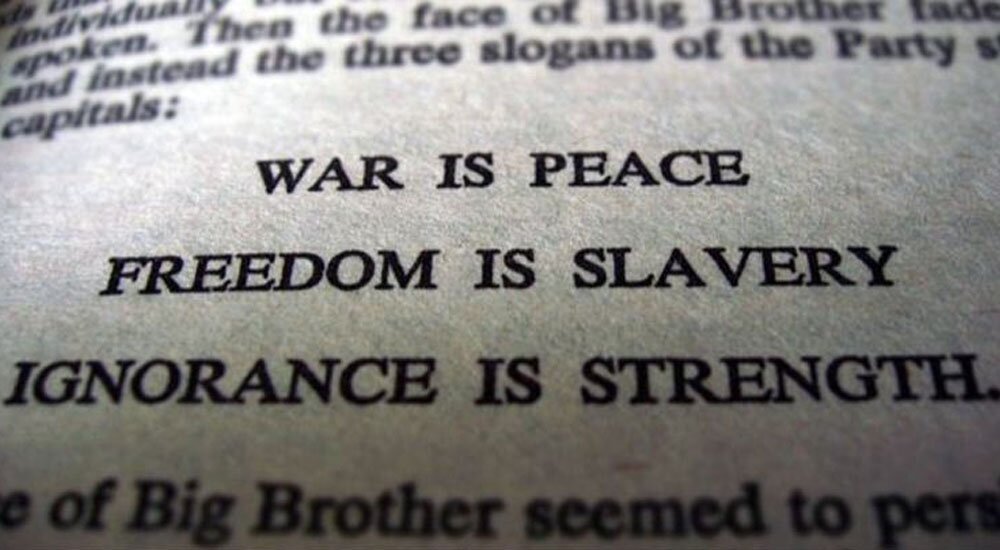
The central thesis of her book is that human freedom is being destroyed in the name of freedom, that is, by a mad quest for absolute freedom, which is leading – inevitably – to a new form of totalitarianism. It’s a disturbing book, to say the least.
William F. Buckley Jr. warned others to “beware the utopians” — and secular religions seem to share a great deal in common with sacred ones in this regard.
What is of interest here is the play of freedom against liberty, or rather a freedom that borders on licentiousness — a freedom that is totalizing rather than enabling. When Pope Francis talks about the “colonization of the mind” and “ideological colonialization” this is precisely the danger he is touching on, efforts to paint Francis as a radical notwithstanding (this publication rejects such a premise).
The problem is always inherent when one set of freedoms collide with another set of earnestly believed freedoms. What occurs then is the Huntington-style version of a clash of civilizations, one that inevitably leads to conflict.
Herein lies the beauty of the Christian West, and of the tradition of Christendom more specifically. True, the experience of rest of the world as they have encountered Europe has been one typified by violence, imperialism, and colonialization. Yet despite this conflict — one that has, it must be mentioned, has typified most of the human experience on this earth — it is the West that has arrived at a tension between tolerance and hospitality.
What is most interesting for those observing the postmodern era are three distinct challenges. First, the tension between this tradition of toleration and traditional ideas of hospitality, the former intrinsically delimiting its goodwill while the latter extrinsically removes all limits. Second, the postmodern arrival of Heideggerian authenticity on the right in the face of Neitzschean vivacity on the left and how this will impact politics in the West. Lastly, the tension between freedom and equality in the postmodern era, as the overreaching habit of the latter to level all the mountains and valleys has produced a technocratic backlash with serious social consequence.
The question here is not whether but when the secular West — both left and right — will fail, and in that failure what tradition supplants it. If one presupposes the victory of freedom, hospitality, and a sincerety-contra-authenticity — the Christian West and the tradition of conservatism might very well have the upper hand in due time.
…provided the lamp of the West stays lit.
Share this:
- Click to email this to a friend (Opens in new window)
- Click to print (Opens in new window)
- Click to share on Facebook (Opens in new window)
- Click to share on Twitter (Opens in new window)
- Click to share on LinkedIn (Opens in new window)
- Click to share on Tumblr (Opens in new window)
- Click to share on Pinterest (Opens in new window)
- Click to share on Reddit (Opens in new window)
- Click to share on Google+ (Opens in new window)
- Click to share on Telegram (Opens in new window)
- Click to share on WhatsApp (Opens in new window)
- Click to share on Pocket (Opens in new window)
- Share on Skype (Opens in new window)